Press Release: 11/24/2026
Lessons About Massachusetts’ Competitiveness from the 2027 Tax Foundation Index

NOVEMBER 23, 2026
BY JIM STERGIOS
SHARE:
Massachusetts ranks 45th nationally, far behind North Carolina, New Hampshire, Florida, and Texas. The Bay State’s tax problems extend far beyond the millionaire surtax
The Tax Foundation’s 2027 State Tax Competitiveness Index is out—and, no surprise, it bears bad news for Massachusetts.
The Commonwealth ranks 45th nationally, down from 39th in 2020. Florida ranks 4th, Texas 5th, New Hampshire 6th, and North Carolina 11th. Massachusetts ranks among the bottom ten states in three of the Index’s five major tax categories:
- Individual income taxes: 43rd, down from 14th in 2022
- Property and wealth taxes: 48th
- Unemployment insurance taxes: 46th
These rankings reflect years of policy choices that have left Massachusetts at a growing disadvantage in competing for businesses, investment, and talent.
State Tax Competitiveness, 2027
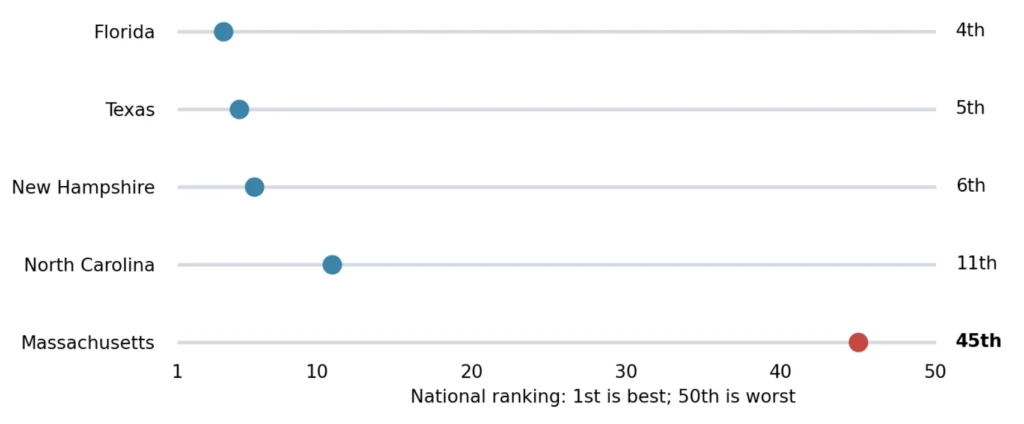
Source: Tax Foundation, 2027 State Tax Competitiveness Index. 1st is best; 50th is worst.
Few states are uniformly high performers on tax policy. What the Index consistently reminds us is that states tax income, property, and business activity very differently.
North Carolina offers a particularly useful comparison for Massachusetts because, like the Bay State and unlike Florida and Texas, it taxes both personal and corporate income. But North Carolina ranks well nationally (4th) on corporate taxes, 6th on unemployment insurance taxes, 12th on sales taxes, and 16th on property taxes—all far substantially better than Massachusetts.
North Carolina has systematically reduced taxes, cutting its individual income tax rate from 4.25% to 3.99% in 2026 and its corporate rate from 2.25% to 2%—the lowest among states that levy one. The corporate rate is scheduled to fall to 1% in 2028 and disappear by 2030. Further personal income tax cuts depend on revenue growth.
As the chart below shows, all states have weaknesses. Texas ranks 46th on corporate taxes, New Hampshire 38th on corporate and 44th on property taxes, and Florida 25th on corporate taxes. Massachusetts, by contrast, ranks poorly across 4 of the 5 categories, and its best showing—on sales taxes—is at the national average.
Five States, Very Different Tax Systems
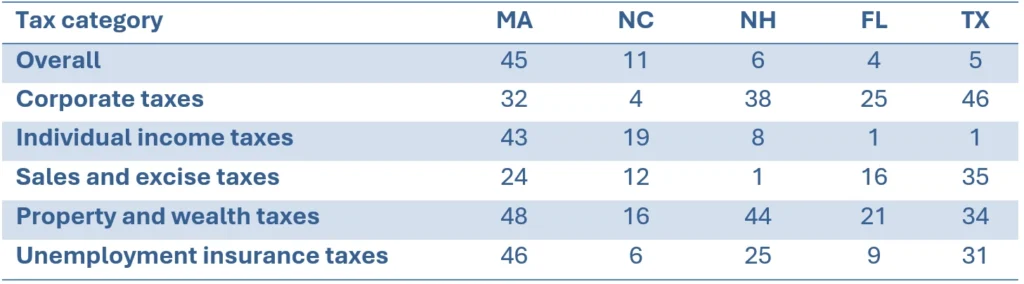
National rankings. Source: Tax Foundation, 2027 Index.
The Income Tax Reversal
On individual income taxes, Massachusetts ranked 14th nationally in 2022 but now ranks 43rd (-29 places). The principal cause was the 2022 constitutional amendment imposing an additional 4% tax on taxable income above $1 million, indexed for inflation, bringing the top marginal rate from 5% to 9%. The surtax applies to income above the threshold, not to a taxpayer’s entire income.
The change also ended Massachusetts’s formerly flat-rate income tax structure. The Tax Foundation specifically identifies the surtax as a major reason for the state’s decline.
Massachusetts Individual Income Tax Ranking, 2020–2027
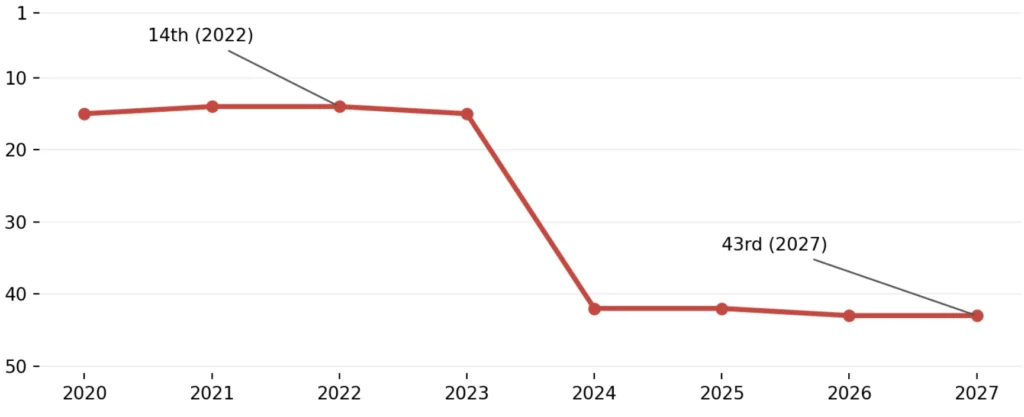
Source: Tax Foundation, Massachusetts historical rankings, recalculated using the current methodology. 1st at top; 50th at bottom.
Massachusetts’s 9% top marginal income tax rate also affects businesses. Owners of partnerships, S corporations, and sole proprietorships generally pay personal income taxes on their business profits. The surtax can also apply to gains from selling a business.
North Carolina’s 3.99% flat income tax rate is less than half Massachusetts’s top rate. Florida and Texas impose no individual income tax, while New Hampshire has eliminated its tax on interest and dividends.
For entrepreneurs deciding where to start, expand, or sell a business, these differences matter. Massachusetts is competing with states that have made deliberate choices to keep income taxes substantially lower.
Taxes on Capital and Property
Massachusetts fares even worse on property and wealth taxes, ranking 48th nationally—just two places from the bottom. North Carolina ranks 16th, Florida 21st, Texas 34th, and New Hampshire 44th.
Proposition 2½ helps restrain property tax growth, but Massachusetts also taxes business assets, some inventory, estates, and real estate transfers. Commercial property can face higher tax rates than residential property. These provisions help explain the state’s poor ranking.
Corporate taxes further disadvantage Massachusetts. With its 8% corporate income tax rate, the Bay State ranks 32nd nationally. North Carolina ranks fourth, having cut its rate to 2%, with further reductions scheduled through 2030. While North Carolina is systematically reducing taxes on business income and investment, Massachusetts maintains a relatively high rate and additional taxes on business capital.
Massachusetts’s corporate excise includes a capital-stock tax, while its throwback rule can subject out-of-state sales to Massachusetts taxation. Restrictions on first-year expensing also prevent businesses from immediately deducting the full cost of certain investments. All three increase the cost of building facilities, purchasing equipment, and expanding operations.
The Cost of Hiring
Massachusetts ranks 46th nationally on unemployment insurance taxes, compared with 6th in North Carolina and 9th in Florida. Even neighboring New Hampshire imposes substantially lower costs on employers.

Source: Tax Foundation, 2027 unemployment insurance tax data. Rates are from applicable tax schedules, not rates paid by every employer.
Massachusetts’s maximum unemployment insurance tax rate is 17.14%, more than twice New Hampshire’s 7.5%. Its minimum rate is 1.17%, compared with 0.1% in New Hampshire. Employers in Massachusetts pay more than twice as much in unemployment insurance taxes as a share of total wages—0.43% versus 0.19%.
Massachusetts also requires employers to wait three years to qualify for experience rating, which adjusts tax rates based on unemployment claims. New Hampshire requires just one year. And Massachusetts can charge employers for benefits paid to workers who voluntarily quit or were dismissed for misconduct—charges New Hampshire does not impose under the circumstances identified by the Tax Foundation.
Although Massachusetts has improved from 49th nationally in 2020 to 46th today, its least favorable statutory schedule still permits a maximum rate of 18.55%, the highest in the country. Employers also face a solvency tax and an additional surtax.
Other States Are Reforming Their Tax Codes
States can substantially improve or deteriorate their tax competitiveness through policy changes. Tennessee climbed 27 places in the Tax Foundation’s Index, from 35th in 2020 to eighth in 2027, following the elimination of its tax on interest and dividends. Nebraska rose nine places to 16th, while Utah improved from 13th to 10th.
Other states lost ground. Washington fell 13 places, from 34th to 47th, while Illinois dropped six places to 38th. California slipped to 49th and New York to last place. Florida, Texas, New Hampshire, and North Carolina remained among the nation’s most competitive states.
State Tax Competitiveness: Winners and Losers, 2020–2027
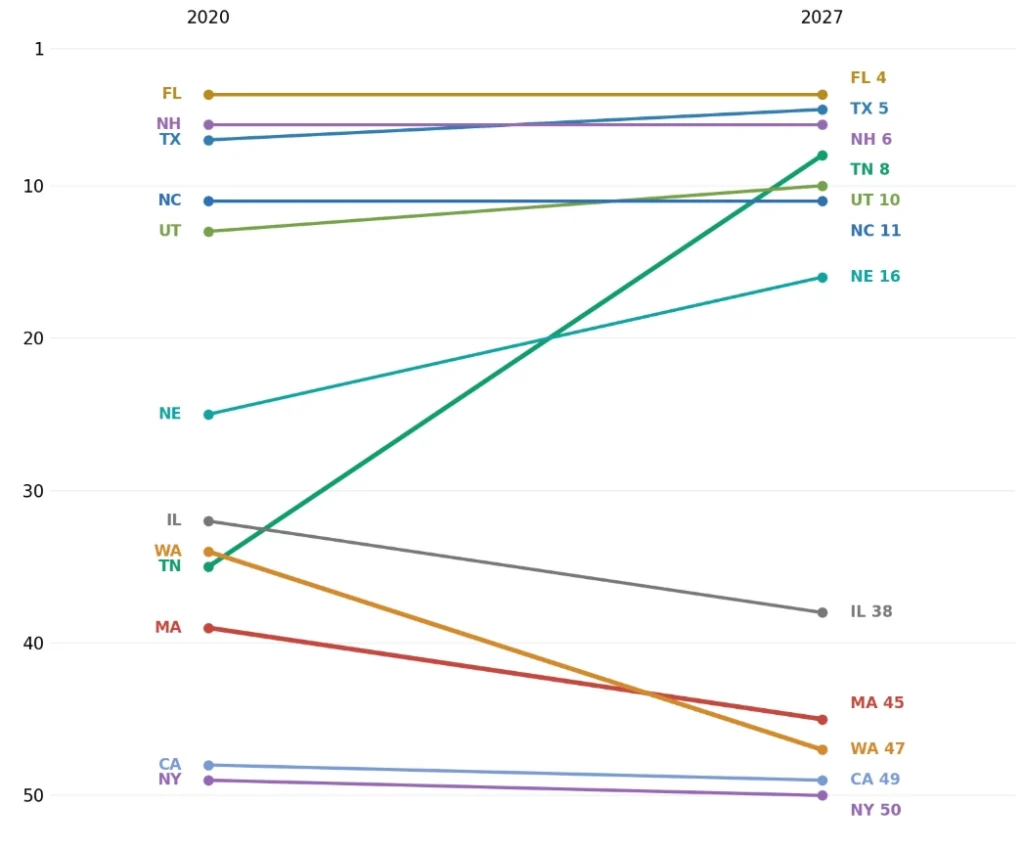
Source: Tax Foundation, 2027 State Tax Competitiveness Index, historical rankings. Upward lines indicate improvement; 1st is best.
Massachusetts fell six places, from 39th to 45th. Its corporate tax ranking remained unchanged at 32nd, while its property tax ranking slipped from 47th to 48th. Unemployment insurance improved modestly, from 49th to 46th.
The largest change was in individual income taxes, where Massachusetts fell 28 places, from 15th to 43rd, following adoption of the millionaire surtax. The Commonwealth’s longstanding disadvantages in taxing property, business investment, and employment now include one of the nation’s least competitive individual income tax systems.
What Massachusetts Must Do
Massachusetts can improve its tax competitiveness by addressing 4 priorities.
- Reduce the personal income tax from 5% to 4% over three years. Alternatively, double the personal exemption, unchanged since 2008, and index it to inflation to provide relief to lower- and middle-income households in a manner commensurate with competitor states.
- Reform estate and business property taxes. Eliminate the corporate capital-stock tax, reconsider taxes on business equipment and inventory, and reform the estate tax. Massachusetts should encourage capital investment, not impose additional taxes on it.
- Overhaul unemployment insurance taxation. The governor should resolve the state’s $2.1 billion federal UI liability, using Rainy Day Fund reserves rather than passing the cost to employers. Reduce excessive maximum tax rates and solvency assessments, tie benefit duration to economic conditions, strengthen fraud controls, and reform experience-rating and employer-charging rules.
- Modernize corporate taxation. Reconsider the throwback rule and allow more generous first-year expensing of capital investments. North Carolina’s multiyear corporate tax reductions offer a model for sustained reform.
The Tax Foundation’s rankings are not a forecast of economic growth. They measure the tax policies states have adopted. Massachusetts ranks 45th nationally, 34 places behind North Carolina. Both states tax personal and corporate income, but North Carolina has systematically reduced rates and improved its treatment of business investment. Massachusetts has moved in the opposite direction.
Massachusetts has changed course before. It can do so again.
Primary sources: https://taxfoundation.org/state-tax-index/ ; https://taxfoundation.org/state-tax-index/states/massachusetts/ ; https://taxfoundation.org/state-tax-index/states/north-carolina/ . Rankings reflect tax law as of July 1, 2026. Policy recommendations are the author’s conclusions, not endorsements by the Tax Foundation.