Press Release: 3/13/2026
Drought concerns continue across Mass.
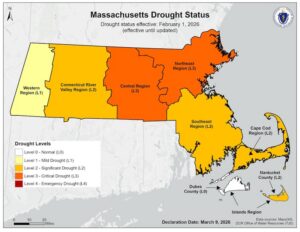
The state’s drought status and resources are available online.
Following limited groundwater recharge over the course of the winter, Energy and Environmental Affairs Secretary Rebecca Tepper on March 9 announced an increase in the drought level for the Central, Northeast, Western and Connecticut River Valley regions, meaning that much of the state now faces significant to critical drought.
Despite a snowy February, there was not enough precipitation to replenish groundwater following an extended drought period over much of the past year, Tepper said. Below-freezing temperatures meant that water stayed locked in snow and the ground remained frozen and unable to absorb water, she said.
“This drought has been building since 2024, and we’re still seeing the effects in low streamflow and lower water levels across the state,” Tepper said. “Even though we had a snowy February, it won’t be enough to replenish the groundwater after such a long period of drought.”
As a result of the recent assessment, the Central and Northeast regions are now at Level 3: Critical Drought, the Connecticut River Valley is now at Level 2: Significant Drought, and the Western Region is now at Level 1: Mild Drought. The Southeast and Cape Cod regions remain at Level 2, while conditions in Nantucket County improved to Level 2.
Dukes County (Martha’s Vineyard) is not experiencing drought conditions.
State officials hope that rainfall and snowmelt will have some impact on replenishing water systems during March.
The state’s drought status and resources are available online.
The state has also developed drought management and water conservation resources for individuals and municipalities to reduce strains on the water supply. Some immediate steps that communities can take include water restriction enforcement, establishing water-use reduction targets, and providing drought and water conservation information to residents and businesses.