Press Release: 3/6/2026
Healey-Driscoll Administration Releases Year Two Progress Report on Early Education and Child Care Task Force
Governor Healey’s Task Force takes a “whole-of-government” approach ensuring affordable, high-quality child care across Massachusetts
FOR IMMEDIATE RELEASE:
3/05/2026
MEDIA CONTACT
Kim N. Le, Director of Communications
Phone
Call Kim N. Le, Director of Communications at 617-823-4874
Online
Email Kim N. Le, Director of Communications at Kim.Le@mass.gov
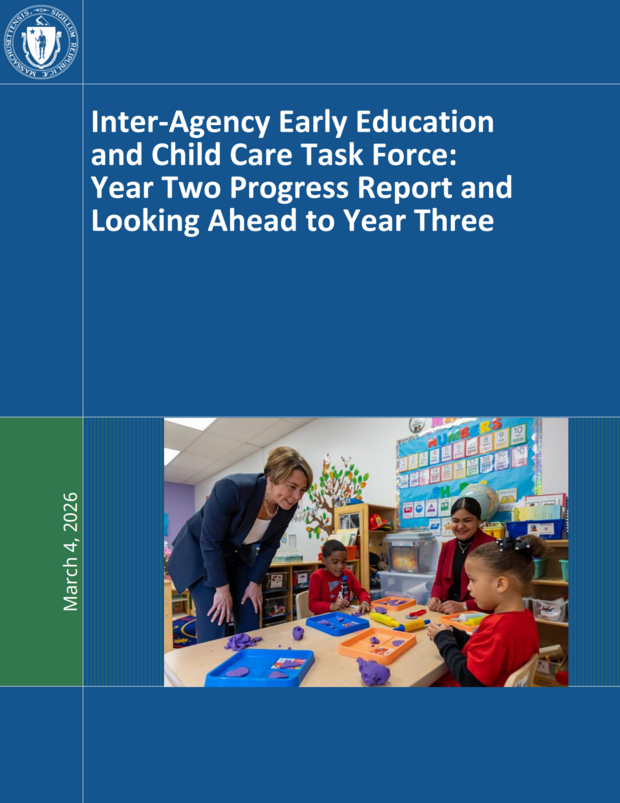
BOSTON — The Healey-Driscoll Administration today released its Year Two progress report and outlook for Year Three from Governor Maura Healey’s Inter-Agency Early Education and Child Care Task Force, highlighting significant progress taken to expand accessible, affordable, and equitable high-quality child care across Massachusetts.
In year two, the Task Force advanced a “whole-of-government" strategy to strengthen the state’s child care system by establishing inter-agency working groups, sharing data and best practices, and launching new, innovative programs to best support providers and early educators. These efforts include expanding health care benefits for early educators, improving economic development support for small, local child care businesses, and expanding career pathways through apprenticeships and higher education opportunities. This progress builds on the 22,000 child care seats Massachusetts has added since before the pandemic and 20 percent increase in educator compensation statewide.
“Affordable, accessible child care remains vital to the competitiveness of Massachusetts and to the long-term success of our families, our economy, and our workforce,” said Governor Maura Healey. “Since taking office, we have expanded child care access for thousands of families, increased wages for educators, and invested in the programs and partnerships that make this system stronger. I’m grateful to the members of the Task Force and the many parents, providers, and educators who shared their perspectives and ideas. Their work is helping guide the steps we’re taking to strengthen child care across Massachusetts.”
“Through our Gateway to Pre-K agenda, Massachusetts is setting a national standard for addressing the complex challenges of the child care system,” said Lieutenant Governor Kim Driscoll. “By bringing together leadership across state government, we’re delivering real, measurable results that make child care more accessible and affordable for families.”
Governor Healey created the Task Force to make Massachusetts a national leader in early education and child care. The Task Force is co-chaired by the Secretaries of Education, Labor and Workforce Development, and Economic Development, and includes participation from Secretaries (or designees) from Administration and Finance, Energy and Environmental Affairs, Health and Human Services, Housing, Public Safety, Technology, Transportation, and Veterans Services.
In its first year, the Task Force conducted 14 listening sessions with hundreds of parents, child care providers, and community stakeholders, to examine innovative practices across other states and countries. That work resulted in nearly 30 actionable recommendations across five core areas: broad access and availability, high-quality programming, sustainable business conditions, affordability for all families, and a strong, supported workforce.
“Addressing the child care challenge requires us to turn over every rock and look across benefits, workforce pathways, and business supports,” said Acting Education Secretary and Early Education and Care (EEC) Commissioner Amy Kershaw. “By working across state government, we’re delivering practical solutions that help providers grow, retain educators, and serve families in every community.”
“The Healey-Driscoll Administration continues to take a whole-of-government approach to investing in an affordable, accessible, and quality child care system in Massachusetts that, in turn, builds a strong talent pipeline of educators plus the infrastructure workers across all industries rely on for caregiving,” said Secretary of Labor and Workforce Development Lauren Jones. "By collaborating with other state agencies combined with external partners, we continue to tap growing models like Registered Apprenticeship to prepare early childhood educators while also supporting caregiving in the workplace initiatives to attract and retain more workers in Massachusetts.”
“We are aligning workforce development strategies, small business resources, and employer partnerships to expand access to child care for families,” said Economic Development Secretary Eric Paley. “Strengthening our child care and early education system is a complex challenge, but Massachusetts has the partnerships and commitment to meet it. When we build a stronger system, we strengthen our talent base and our long-term competitiveness as a state.”
Key progress in Year Two includes:
- Expanding Benefits for Early Educators
- The administration partnered with the Health Connector for Business (HCB) to host webinars on affordable health insurance options for early education and care providers, reaching more than 200 participants. Webinars were translated into five languages, recorded, and continue to be shared statewide by EEC.
- Building on this success, the collaboration is expanding to include MassHealth to better meet early educators’ needs.
- Supporting Child Care as a Business
- Launched the Business Front Door through the Executive Office of Economic Development (EOED), designating early education and care as a priority sector for economic development support.
- Providers can now access a dedicated navigator through EEC to connect them with financing, workforce, and business support resources.
- Building Career Pathways and Apprenticeships
- Partnered with community colleges to create a foundational early childhood certificate to improve consistency, transferability, and degree attainment for students pursuing careers in the field.
- Created a companion guide to help students navigate early education career pathways.
- Secured more than $6 million in federal funding to expand registered apprenticeships in early childhood education and awarded $1.8 million in GROW grants to eight organizations to train and place more than 300 early childhood education apprentices statewide.
- Employer Child Care Innovation Fund
- The FY25 budget included $2.5 million to launch a competitive matching grant program to encourage employers to invest in child care solutions for their workforce.
- EEC, in partnership with Commonwealth Corporation Foundation, EOED, and EOLWD, is reviewing responses to the program’s Expression of Interest.
As the Task Force enters its third year, the Healey-Driscoll Administration remains focused on building a sustainable, equitable early education and child care system that supports educators, families, employers, and communities across Massachusetts.
Learn more about the Inter-Agency Early Education and Child Care Task Force and read the updated report at Mass.gov/ChildCareTaskForce.